
Specialty
Pediatrics
Pedodontics is the part of dentistry that deals with children.
Due to the sensitivity inherent in children, maximum precautions must be taken to ensure that the first visits go well; some bad memories can remain etched in the mind for a lifetime, disrupting all subsequent care.
Even more so than with an adult, the practitioner must nurture the communication and the personal and authentic relationship with the child in front of them, especially during a very first intervention or first visit. For this, they need to focus less on words with a very uncertain meaning for a child and more on the conciliatory attitude and the overall expression conveyed. It is only by establishing a relationship of trust that the conditions for satisfactory care will be met.
Caries can progress very quickly in children.
Regarding the prosthesis, if a tooth is very damaged, a kind of pre-shaped crown can be placed, called a pediatric cap.
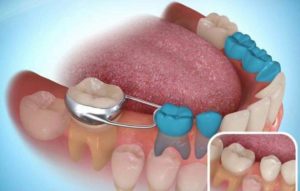
Small removable resin appliances can also be made if several teeth have been extracted early before their normal date of eruption. The goal is twofold: aesthetic if they are front teeth; space maintainer if they are back teeth. Indeed, when a tooth is removed, adjacent teeth are at risk of moving towards the space left vacant. The permanent teeth then risk no longer having the space to erupt.
THE DENTAL PREVENTION MEASURES:
-Oral hygiene education:
The EHO is the starting point for all our therapies. It is essential to make your child understand the importance of good oral hygiene. Adopting the right practices is a guarantee for oral health.
-Sealing of furrows:
The sealing of the grooves mainly affects the first and second permanent molars. The grooves of these first teeth are deep and narrow, inaccessible to the toothbrush.
A white resin that resists decay infiltrates its grooves and permanently protects the tooth. An endocrine-disruptive-free material can also be used for the same indication.
In some cases, the sealing of the groove can also affect the temporary molars.
-Application of fluoride and use of interdental equipment:
When used properly, fluoride is our friend.
The fluoride applied to the teeth integrates into the enamel and increases its resistance to acid attacks. To date, fluoride remains the best antibacterial agent against cariogenic bacteria because it also disrupts their metabolism.
If your child has a moderate or high caries risk, a fluoride application may be offered to them in their chair in addition to brushing twice to three times a day.
In some cases and depending on your child’s age, the use of interdental devices may also be indicated. This will involve helping them to use a simple device, preventing a recurrence of caries. (photo of interdental device?)
Dental caries:
Tooth decay of the temporary tooth, as well as the permanent tooth, can be responsible for pain and must be treated promptly.
Scar lesions are not always visible to the naked eye.
If your child has one or more cavities, it is first necessary to find the cause in order to prevent a recurrence.
For a superficial caries lesion, the tooth is reconstructed with a white material adapted to the color of your child's teeth (composite or CVI).
If the tooth has a too deep caries lesion and/or a defect in the enamel, a dental crown may be indicated.
The pediatric hairstyle:
The metal pediatric crown may be indicated for teeth that are too damaged by decay or an anomaly in the structure of the enamel.
It increases the mechanical resistance of the tooth over time, maintains the necessary space for the future permanent tooth, and maintains a good masticatory cycle for harmonious bone growth.
Molar-incisive hypomineralization (MIH):
MIH corresponds to a structural anomaly of the enamel (mineralization defect). It affects only the child’s first permanent molars (one to four), with or without damage to the permanent incisors.
This disease is also found in temporary teeth, but under a different name.
The origin of MIH is still poorly understood, but endocrine disruptors are thought to be responsible.
Clinically, we observe: visible enamel loss in some cases as soon as the tooth erupts; the presence of whitish or brown-yellow opacity, especially on the incisors; and significant destruction of the tooth despite a low caries risk.
In the absence of treatment, these children develop dental hypersensitivity to heat, cold and air, caries lesions due to enamel loss and an aesthetic disorder (front teeth).
For effective care, monitoring and treatment must be initiated as early as possible.
Dental extraction:
Extraction of the baby tooth is indicated for a displaced tooth that interferes with chewing, a displaced tooth close to the root of the permanent tooth, significant mobility, or a dental infection. This is an emotional procedure for both the patient and the practitioner. Your child’s comfort and well-being are my priority; our entire team is on hand to ensure that this procedure takes place smoothly and under the best possible conditions.
MEOPA:
Fear of the dentist (representation, bad experience) is a real obstacle to access to care, especially for young children.
Conscious sedation or MEOPA is an excellent alternative. Improving the well-being of the child means reducing their anxiety and allowing the practitioner to provide high-quality care.
Conscious sedation is an inhalable medication (oxygen/nitrous oxide) administered through a nasal mask, quick, reversible, and quickly eliminated from the body. It allows the patient to be relaxed while still awake.
Its use is very simple but still requires the cooperation of the patient.
The preservation of space:
The role of the milk tooth is primarily functional: maintaining the necessary space for the future permanent tooth and stimulating the surrounding bone growth. It is therefore essential to preserve it for as long as possible.
Otherwise, removable or fixed small appliances may be offered to replace one or more teeth that have been extracted too early, before their normal date of eruption. The goal is twofold: aesthetic, especially for the front teeth (incisors); and functional, maintaining space and bone growth (posterior teeth). Indeed, after an extraction or in cases of agenesia, the adjacent teeth risk migrating towards the vacant space. The permanent teeth then risk no longer having the space to erupt.
Dental trauma:
Dental trauma in young children and adolescents is common. To limit its consequences, it is necessary to immediately notify the treating dentist to ensure prompt and effective treatment.
A follow-up schedule is put in place to verify that the evolution is positive over time.
An initial medical certificate will also be provided at the end of the session; it allows the start of the process of receiving treatment from insurance companies.
If your child experiences dizziness, vomiting, or any other sign of a general state of change immediately after the shock, hospitalization by a medical emergency service will be the first step.
Your specialist
Dr. Félic Trumbic
Dentist
Dr Marion Mingoutaud
Dentist
Dr Thibaud Gibier
Dentist
My Dental Clinic
My Dental Clinic
119 Rue du Président Wilson
Ground floor on the right
92300 Levallois-Perret
contact@mon-cabinetdentaire.com
Tél: 01 42 67 05 04
Monday-Friday: 9:00 a.m. to 7:00 p.m.
Sam: 9:00 a.m. to 4:00 p.m.