
Cosmetic dentistry
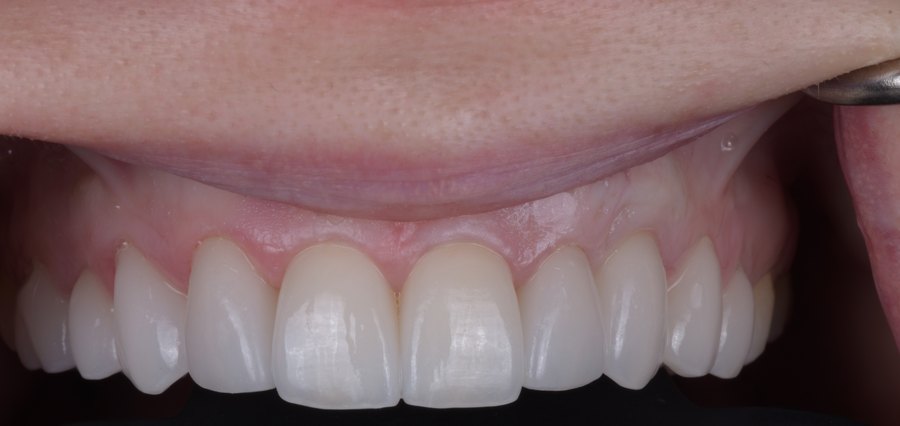
A veneer is a thin layer of ceramic, custom-made by the dental technician and bonded to the visible surface of a tooth. It changes the colour, shape, length or apparent alignment of the front teeth while preserving as much of the natural tooth as possible.
What are veneers for?
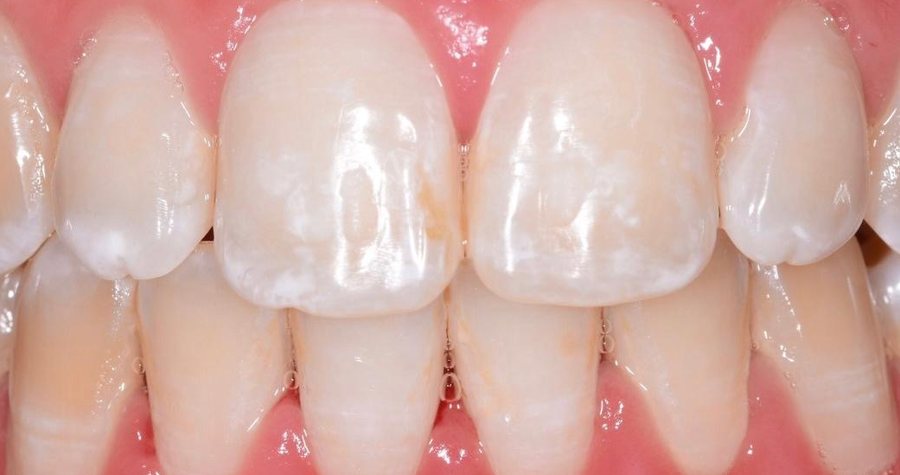
- Heavily discoloured or stained teeth that whitening cannot lighten enough.
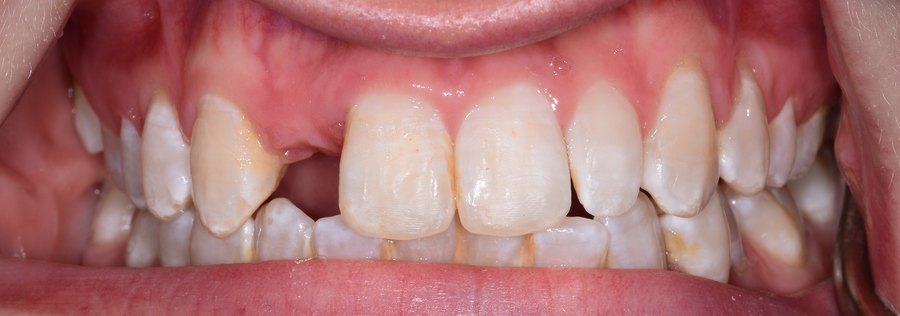
- Worn, chipped or short teeth.
- Irregular shapes, or teeth whose proportions do not match.
- Small gaps between the teeth or slight misalignments, when orthodontics is not wanted, or alongside it.
- Old resin fillings that have yellowed or worn.
Before starting: the smile design
The first consultation begins with an examination of the teeth, the gums and the way the teeth meet. The gums must be healthy and any decay treated before veneers are placed: periodontitis is treated first. We also look for clenching or grinding (bruxism), which has to be taken into account when designing the treatment.
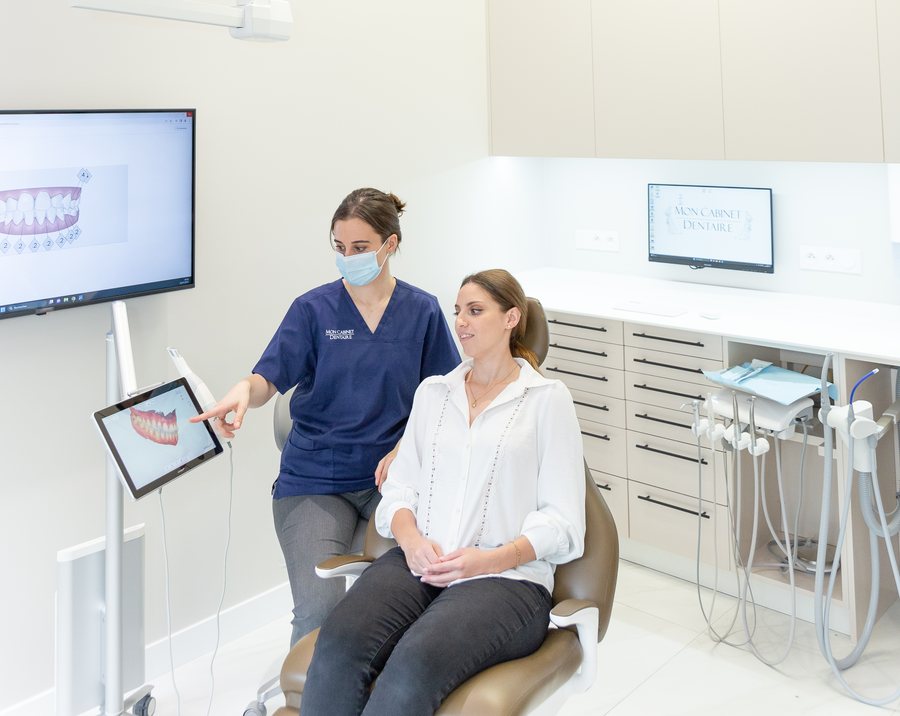
Photographs and videos of the smile, a digital impression and, if needed, radiographs are then used to design the future smile on a computer: the shape and length of the teeth, their proportions and the smile line, in harmony with the face and lips.
The design is then tried in the mouth: this is the mock-up, a temporary resin placed over the teeth without touching them. The patient sees the future smile, discusses it with the practitioner and can ask for changes before anything is final. Depending on the situation, other options may also be suggested: whitening, orthodontics or composite.
Choosing the shade
The shade is chosen with the patient, using a shade guide (a range of tooth-colour samples) under suitable lighting, taking into account the neighbouring teeth, the complexion and the result the patient wants, more natural or brighter.
Photographs taken with the shade samples are sent to the dental technician, who builds up the ceramic in several layers to reproduce the translucency of the tooth edge and the nuances of a natural tooth. If whitening is planned, it is done first: the shade of the veneers is then chosen on the whitened teeth.
A preparation that preserves enamel
Enamel is the hard, shiny layer that covers the tooth, and bonding holds best on enamel. A clinical study found that veneers bonded partly to dentin, the layer beneath the enamel, failed about ten times more often than veneers bonded to enamel.
The aim of the preparation is therefore to keep as much enamel as possible. It is guided by the design validated in the mouth; only the thickness needed for the ceramic is removed, often a few tenths of a millimetre, and sometimes nothing at all when the tooth only needs to gain volume.
While the final veneers are being made, temporary veneers protect the prepared teeth and already give a preview of the smile.
Placement: bonding under a rubber dam
Before it is bonded, each veneer is tried in with a paste of the same shade as the cement: the shape, shade and fit are checked with the patient, who gives their agreement before bonding.
The teeth are then isolated under a rubber dam: a thin, flexible sheet stretched around the teeth keeps them dry, away from saliva and the moisture of breathing, throughout the bonding. This isolation is one of the conditions for a strong and lasting bond.
Bonding follows a precise protocol: the tooth surface and the inside of the veneer are prepared, the veneer is seated, the cement is light-cured, then the excess is removed and the margins polished. Finally, the occlusion, that is the way the teeth meet, is checked.
When precision requires it, bonding is carried out under the operating microscope: magnification and lighting make it possible to check the seating of each veneer and to remove excess cement right at the gum line.
Ceramic or composite?
Composite veneers, made of a tinted resin, are shaped on the tooth or made with a transparent key; they suit certain situations, particularly in young patients, and are easy to repair. Ceramic keeps its shade and polish better and wears less. In a comparative trial followed for ten years, all the ceramic veneers were still in place, compared with three out of four laboratory-made composite veneers.
How long do veneers last?
In a study that followed nearly 500 ceramic veneers for up to 21 years, 96% were still in place after 10 years and 91% after 20 years. These figures do not apply to every case: longevity also depends on hygiene, habits and follow-up.
Veneers are brushed like natural teeth, with floss or interdental brushes between the teeth, and are checked at the practice during regular check-ups. If you clench or grind your teeth, a night guard protects them. It is best to avoid biting hard objects, such as fingernails or a pen.
When veneers are not indicated
- Gums or teeth that need treatment first (decay, periodontitis).
- Insufficient oral hygiene, to be improved before treatment.
- Severe bruxism without protection.
- Badly damaged teeth, for which a crown or an onlay is more suitable.
- Major misalignment of the teeth, which first calls for orthodontics.
Sources
- Gurel G. et al., “Influence of enamel preservation on failure rates of porcelain laminate veneers”, International Journal of Periodontics & Restorative Dentistry, 2013 (accessed 24 October 2026)
- Gresnigt M. M. M. et al., “Randomized clinical trial on indirect resin composite and ceramic laminate veneers: up to 10-year findings”, Journal of Dentistry, 2019 (accessed 24 October 2026)
- Layton D. M., Walton T. R., “The up to 21-year clinical outcome and survival of feldspathic porcelain veneers: accounting for clustering”, International Journal of Prosthodontics, 2012 (accessed 24 October 2026)